Sage Gautama, approaching the Lord, asked him:
- You who know all the laws, you who know all the sciences, tell me, Lord Shiva, how to awaken the mind to the knowledge of Brahman.
To which Siva replied:
First, learn the laws, and thoroughly assimilate the teaching of the Lord of the Trident, only then, Gautama, will I tell you the Truth as revealed to me by the Mountain Goddess.
This truth is secret, it must not be divulged. I reserve it for the perfect adept, for whom yoga makes a jewel case worthy of the finest jewels. It is the true knowledge of So-Ham, and through it, one obtains freedom forever.
So I will tell you what this doctrine is and what Ham-Sa and Para-Hamsa are because you are a self-controlled (celibate) novice devoted to study. The teaching is that one must meditate again and again on the Ham-Sa, continuously repeating Ham Sa Ham Sa . . .
He enters into all beings, the Ham-Sa, the Atman, and becomes present in them like fire in friction sticks, like oil in sesame. To know this is to conquer death.
The adept, first of all takes the lotus posture and tints the breath he inhales; then pressing his anus with his left heel, he causes the breath to rise from the center of the base to the door of the jewels, not without having led the breath to revolve three times around the Svadhisthana; from there the breath rises to the Anahata and passes it, gaining the Vishuddi, which is flanked by two balls of flesh similar to testicles; still holding the breath, the adept then leads the inhaled air to the Ajna-chakra and the Brahmarandhra; meditating, he finally realizes that he is the one with three letters, Om. He: Being, thought, and bliss—beyond all form.
He is the supreme Ham Sa, resplendent with the light of ten million suns, and by whom all things have been penetrated.
Now dwelling in the lotus of the heart, he finds there eight incitements corresponding to eight petals: the eastern petal inclines toward pious actions. The petal of Agni inclines toward slumber, to laziness, and the petal of Yama, to cruelty. The petal of Nirrti incites wrongdoing. In Varuni, the Goddess lies in thirst of pleasures, and in Vayavi, the desire to travel. The petal of Soma inclines toward sensuality, and that of Isana the pursuit of material goods. In the middle of the lotus lies the disgust that follows satiety, and the stamens govern the waking state, the pericarp governs the state of light sleep, and the androecium governs deep sleep. As for the fourth state, Ham reaches it when he leaves the lotus.
It then goes even beyond this fourth state when within it the resonance—which circulated throughout the subtle body from the center of the base to the Brahmarandhra—is extinguished like the song of a pure crystal. This resonance is said to be Brahman, the Supreme Soul.
Of this mantra, Ham-Sa is the Seer, the meter Gayatri, the dedicatee Parama-Hamsa, the verbal seed, Ham, is the seed syllable (bija), it is He. So is his Shakti (his power) and Ham-Sa (So Ham) the sharp point: I am He!
This mantra must be repeated twenty-one thousand six hundred times, meditating on the six centers night and day, dedicating this meditation to the sun and the moon, the impassive Lord, and the unmanifest Brahman. We will thereby incite the subtle and formless element which is deep within us.
This mantra we use for the touching rites, starting with the heart, we continue to all the members by repeating the ritual interjection: vausat for Agni and Soma;
At the end of the rite, we meditate on Ham-Sa nestled in the cave of the heart, that is to say, in the Atman.
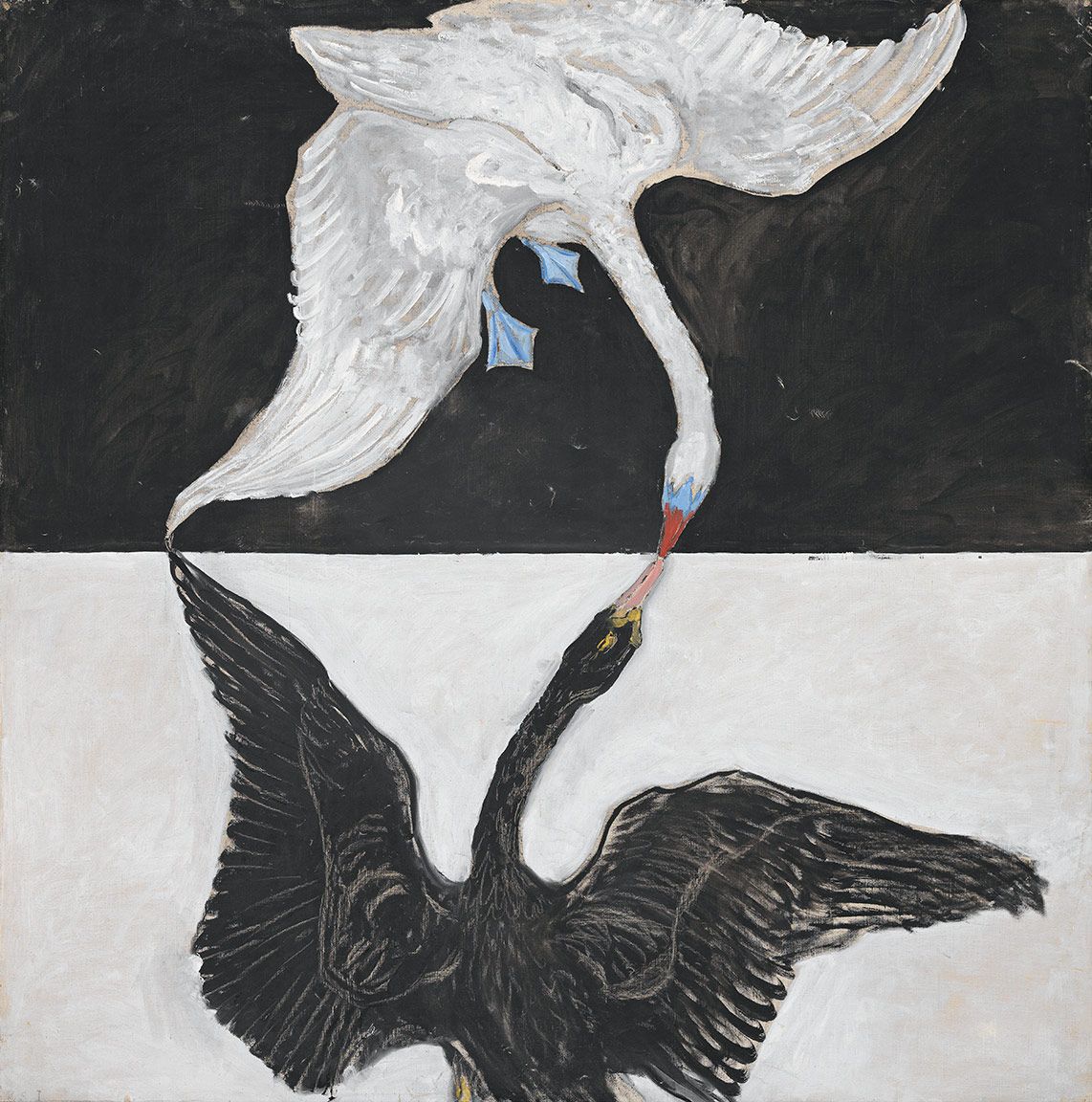
Of this bird, Agni and Soma are the wings; Om is the head, of which AUM and the bindu of Om are the three eyes and his face. Rudra and his consort are the two legs; such are the representations that are used in the double rite performed from the throat; the close union between the Hamsa and the Parama-HamSa (Self and Self) is accomplished in two stages, the dual union and the absolute union.
At the conclusion of this rite, the ajapa mantra ceases where the beyond of thought begins. [Unmani, which means absence of thought. In the end of the rite, we meditate on Ham Sa nestled in the cave of the heart, the heart of the heart, the Atman.]
One can also cognize the sound by repeating the mantra ten million times; the sound then manifests itself in ten ways as follows: we first hear chin, then secondly chini, chini; the third sound is that of a bell; the fourth of a conch shell; the fifth of a string; the sixth of a cymbal, the seventh of a flute, the eighth of a drum, the ninth of a bass drum, the tenth finally is that of thunder.
We must neglect the first nine sounds and concentrate our attention on the tenth, which is that of thunder.
At the first sound, the body of the adept sounds chin chini; in the second, this disappears; at the third the lotus of the heart is pierced; at the fourth, the head trembles; at the fifth, the palate oozes; in the sixth, ambrosia is drunk; in the seventh, we see the mystery; in the eighth, the word is heard; in the ninth, the body becomes invisible and the divine eye opens, without defilement; it becomes Brahman at the tenth, achieving the union of the soul and Brahman.
From then on, and by this very fact, the individual mind is destroyed, which is the source of thoughts and desires like images and mental constructions [sankalpa and vikalpa]; then, from the cessation of these two activities of the mind but also from the extinction of positive and negative acts, is born the transfiguration of the disciple into Sada Shiva, [literally, the always Shiva] the revealer who shines of the nature of Shakti, the Omnipenetrating, which is in essence radiant splendor, which is the immaculate, the eternal, the pure, and the supremely peaceful Om.